
‘Choreographic Samplers’
Alejandra Mizrahi
& Unión Textiles Semillas
Curated by Gema Darbo
Presented by Apsara Studio
February 20th – March 7th 2026. Apsara Studio, 200 Battersea Park Rd, SW11 4ND London
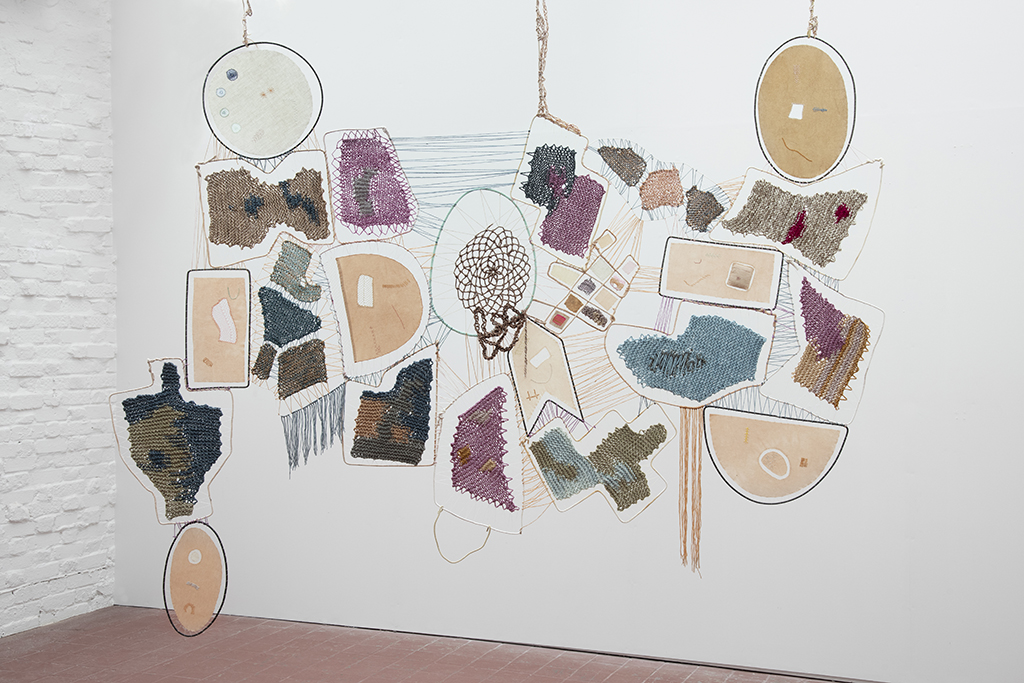
Alejandra Mizrahi, Copla para una coreografía, 2026. Natural dyes, hand knitting (two needles), felt, lace edgings (randas) and embroidery. Image: Studio AURA
Choreographic Samplers brings together a selection of recent works by Argentinian artist Alejandra Mizrahi, including individual works and collaborations with Unión Textiles Semillas. For several years, dechados (samplers) have become a central textile device in Mizrahi’s practice, not only as material expression but as a working method. Samplers, as prompts for practice and learning, evolved from functional objects created by women into historical archives, where patterns, motifs, and stitched words unravel ways of knowing, oftentimes outside formal education and canonical art narratives.
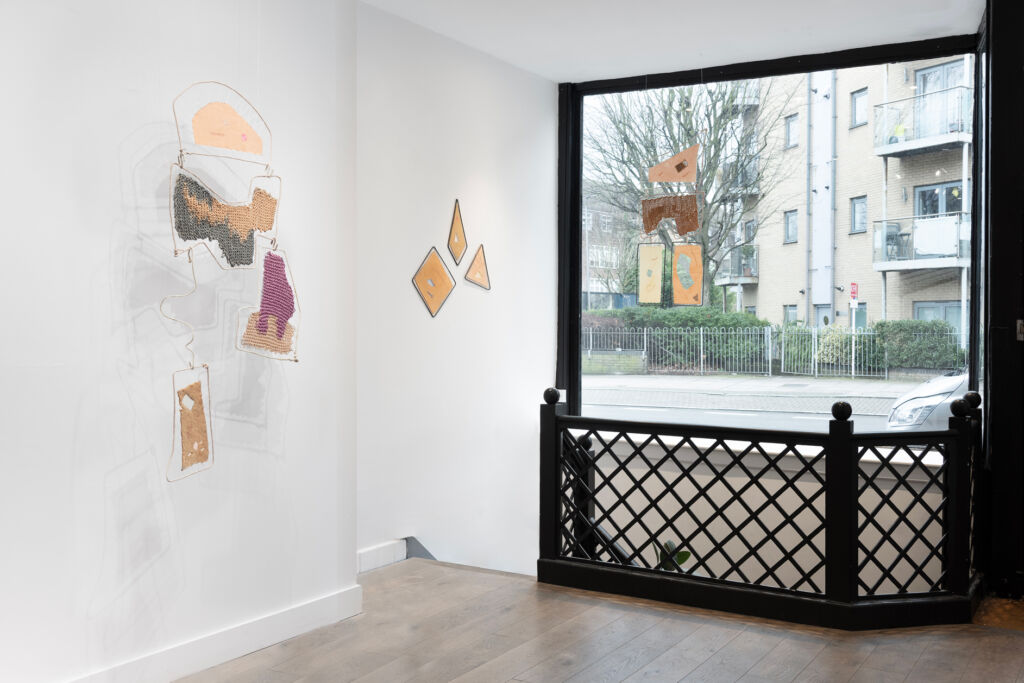
Left to right: 3 (de la serie Coplas), 2025 Natural dyes, two-needle knitting, felt, lace edgings and embroidery; Sin título 2 (de la serie Fantasía aplicada) 2022. Cotton fabric dyed with natural dyes, embroidery and lace edging; 4 (de la serie Coplas), 2025 Natural dyes, two-needle knitting, felt, lace edgings and embroidery. Image: Studio AURA
Moving beyond knowledge as something that emerges from absence or representation, Mizrahi’s practice shifts attention to questions of relationality and mutuality transmitted through textiles across geographies and temporalities. In this sense, Choreographic Samplers engages with forms of ancestral knowledge, textile techniques, oral traditions, cultural (dis)continuities, situated practices and care to advance new modes of artistic co-production and coming together. This is reflected, for example, in her long-term companionship with Randeras de El Cercado, a community of women who create Randas, a reticular lace technique shaped by histories of migration and transformed into a local cultural expression.
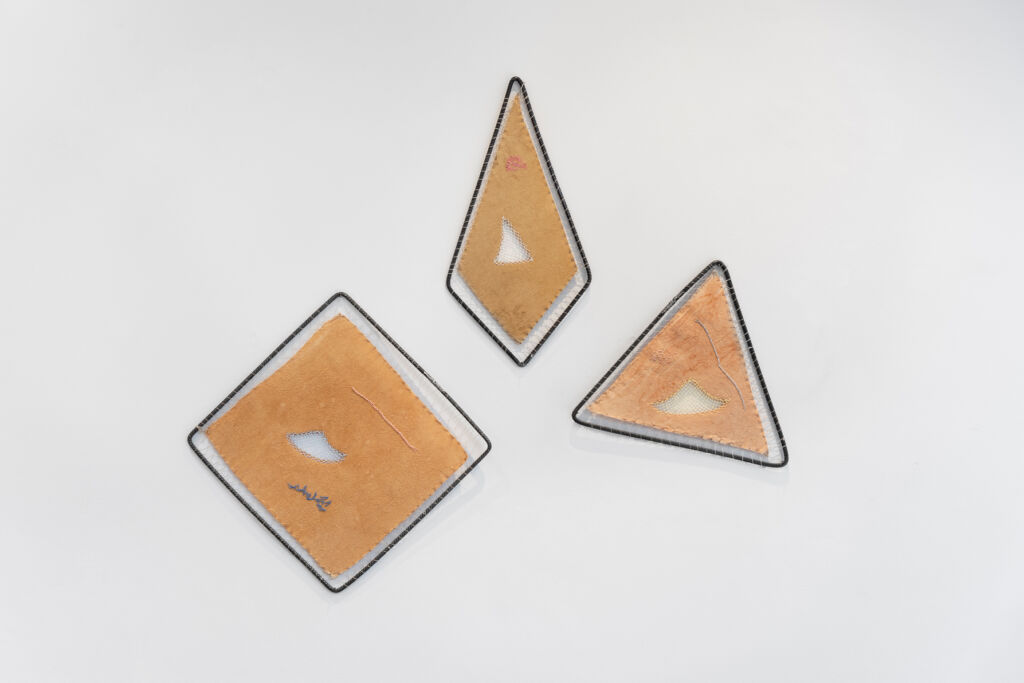
Sin título 2 (de la serie Fantasía aplicada) 2022. Cotton fabric dyed with natural dyes, embroidery and lace edging. Image: Studio AURA
Included in this show are three interwoven bodies of work. In Fantasía Aplicada, Mizrahi works with stretched textiles dyed with natural pigments, such as those found in avocado pits, onion skins, or cochineal. The haptic tension between the cold, rigid structure of the frame and the warmth of the cloth results in embroidered flowers, bird-like silhouettes, and drifting lines, alluding to what Mizrahi states as: ‘the act of working the cloth to draw out effects of the earth’ – This material and sensorial relationship signals the transformation of imposed colonial knowledge into local life forms and meanings. Copla mobilises textiles as languages of resistance, in which braiding, colour, symbols, and technique operate as social and affective dimensions that sustain historical trajectories and political struggles in the region. Covers, in turn, combine the reticular pattern of the randa with the structural logic of samplers. The resulting delicate pieces reference domesticity, meditative repetition, and the intimate dimension of craft gestures that are set against technological immediacy.
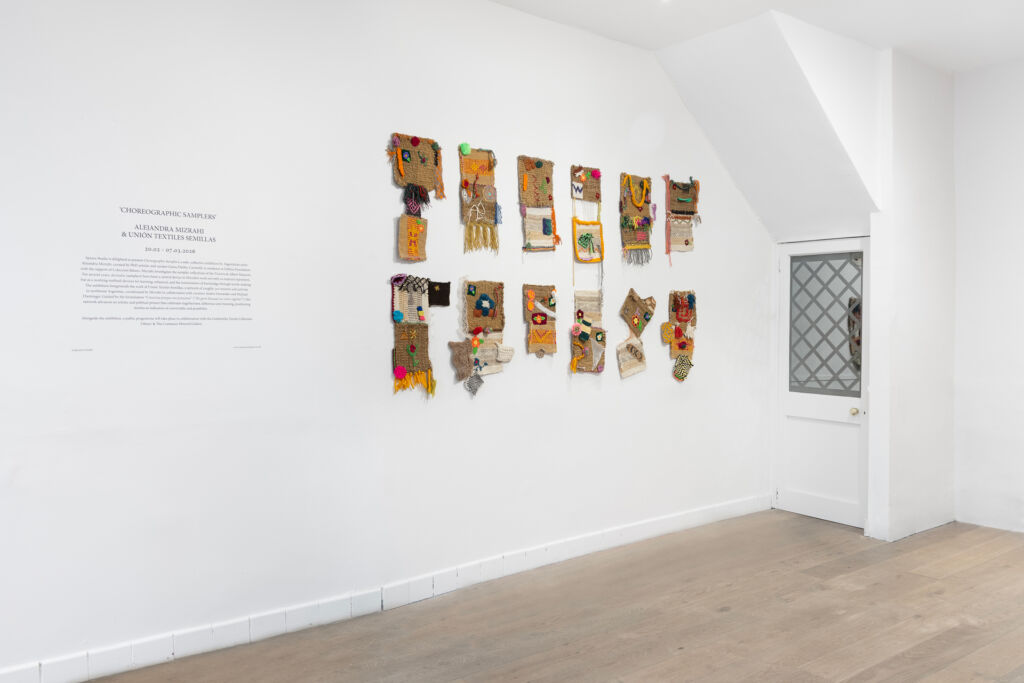
Unión Textiles Semillas. Quepi | Atado mágico, 2024. Image: Studio AURA
Assuming the choreographic as a connective tissue between individual and collective forms in Mizrahi’s practice, the exhibition foregrounds the work of Unión Textiles Semillas, a network of roughly 300 weavers, artists and activists in northwest Argentina, coordinated by Mizrahi with curators Andrei Fernández and Michael Dieminger. Guided by the formulation “Crecemos porque nos juntamos” (“We grow because we come together”), this network advances an artistic and political project that celebrates togetherness, difference and meaning, positioning textiles as indicators of conviviality and possibility.
Quepi: Atado mágico brings together twelve textile works woven collectively by twelve women-led groups. Each piece is composed of different fibres, patterns, colours, and rhythmic geometries. Beginning from an initial fragment of sheep’s wool dyed with carob resin, each weaver leaves a trace through a gesture that bears witness to an exchange of knowledge, through which shared forms of desire are activated across a common surface. Ultimately, the choreographic is understood not only as a redistribution of authorship, but as an indicator of collective thinking and making that establishes the conditions for the creation of a textile ecosystem: one in which a world—or many worlds—coexist and continue to be woven in the present.
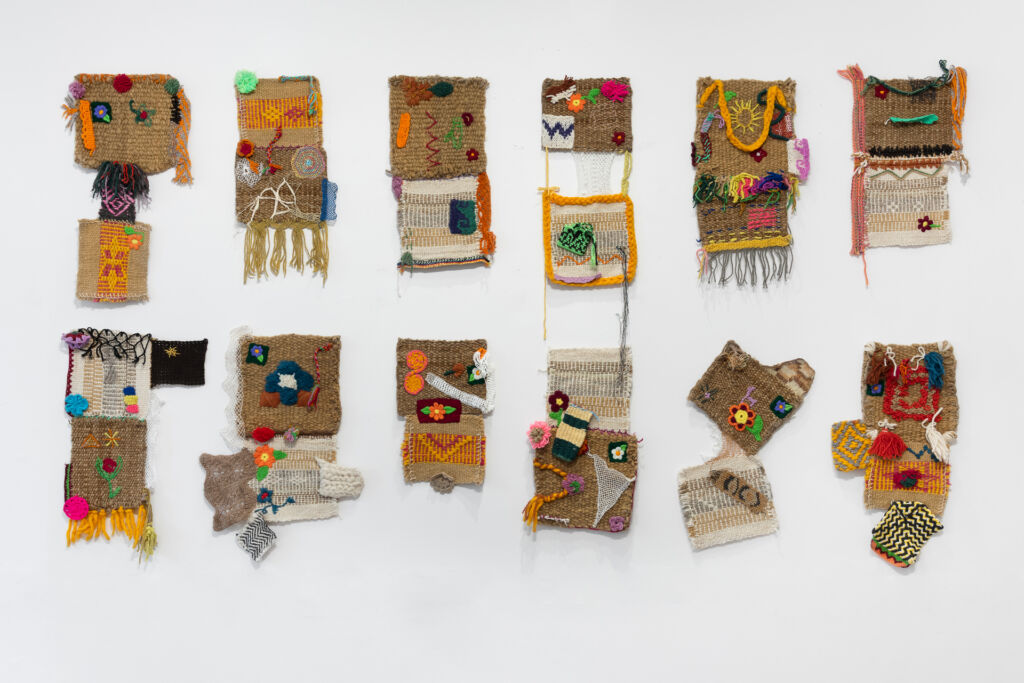
Unión Textiles Semillas. Quepi | Atado mágico, 2024. 12 knitted pieces; standing looms, backstrap looms, and frame looms; needle lace, interlaced work, and embroidery, made with llama fiber, sheep’s wool, chaguar, cotton, and industrial yarns. The yarns are dyed with natural dyes: rhubarb, algarrobo sap (‘lloro de algarrobo’), walnut, eucalyptus, yerba, onion, chinchilla, cochineal, beetroot, jarilla, and wild herbs, as well as with artificial dyes. Image: Studio AURA
Alongside the exhibition, a public programme will take place in collaboration with the Goldsmiths Textile Collection Library & The Constance Howard Gallery.
Alejandra Mizrahi (Tucumán, Argentina) graduated in Arts from the National University of Tucumán and holds a PhD in Philosophy from the Autonomous University of Barcelona. She is currently a lecturer in the Fashion and Textile Design Program at the National University of Tucumán. Since 2012, she has worked with Randeras de El Cercado, a community of traditional weavers. In collaboration with curator Andrei Fernández, she also coordinates Textiles Semillas, a union of weavers, artists, and activists from northwestern Argentina as part of the 99 Questions Program of the Humboldt Forum. Alejandra’s work features in the permanent collections of the Modern Museum of Art, Buenos Aires; the Palais de Glace, Buenos Aires; the Castagnino MACRO, Rosario; and numerous Argentinian private collections. She is currently in the roster of de Sousa Galería, Buenos Aires.
Unión Textiles Semillas is a group of weavers, artists, researchers, educators, and activists from northern Argentina. Bringing together nearly three hundred women, UTS emerged from the desire to connect territories, knowledge exchange, and support craft textile practices. Founded in 2023 by Andrei Fernández, Alejandra Mizrahi, and Michael Dieminger, the founding groups are: Achalay Tejidos (Niogasta, Tucumán), Cooperativa La Pachamama (Amaicha del Valle, Tucumán), Flor de Altea (Santa Ana, Jujuy), Flor en Piedra (Caspalá, Jujuy), Randeras de El Cercado (Monteros, Tucumán), Silät (Santa Victoria Este, Salta), Tramando sueños de lana (Quilmes, Tucumán), Tejedores Andinos (Huacalera, Jujuy), Teleras de Atamisqui (Atamisqui, Santiago del Estero), Teleras de Huilla Catina (Loreto, Santiago del Estero), Tinku Kamayu (Lampacito, Catamarca), and Warmipura (Tafí del Valle, Tucumán). In addition, the UTS includes a group of Sembradoras, who carry out intercultural management and research while accompanying and caring for the growth of the group.
Unión Textiles Semillas has participated in: Artes de la Tierra at the Guggenheim Museum Bilbao (Bilbao, 2025); Asamblear at Linse Galería (Buenos Aires, 2025); La crecida que mismea on Miguel Aráoz pedestrian street during the fifteenth Encuentro de Tejedoras in Amaicha del Valle, Tejiendo experiencias (Tucumán, 2025); Pinta Lima Art Fair (Lima, 2025); Textile stories: a living achieve at Comfort Station (Chicago, 2024); Convivio UTS, in Silat Wuké, La Puntana community, in Santa Victoria Este (Salta, 2024); On the poetics of loose ends at the Humboldt Forum (Berlin, 2024); Cantando bajito: chorus at the Ford Foundation (New York, 2024); Group Residency at URRA (Buenos Aires, 2024); Textiles Semillas at the Centro Cultural y Museo de la Sacha Guitarra in Atamisqui (Santiago del Estero, 2024); Jornadas de Arte Textil, a lecture series held in the context of the exhibition Soñar el agua at the Museo de Arte Latinoamericano de Buenos Aires (Buenos Aires, 2024); Textiles Semillas at the Museo Arqueológico de Tilcara Dr. Eduardo Casanova in Tilcara (Jujuy, 2023); Interwoven Narratives, New York Textile Month (2023); Textiles Semillas at the Faculty of Arts, National University of Tucumán (Tucumán, 2023); Peregrinaje at the thirteenth Encuentro de Tejedoras in Amaicha del Valle, Tejiendo experiencias, at School No. 10 Claudia V. de Cano (Tucumán, 2023); Textiles as Seeds at Delfina Foundation (London, 2023).
Gema Darbo is a curator and doctoral researcher in Advanced Practices at the Department of Visual Cultures, Goldsmiths, University of London. Her research focuses on polycrisis as an infrastructural mechanism for rethinking curatorial approaches and modalities. She has taken part in long-term collective research initiatives such as Absent Audience (2020–2022) and worked as a research associate on Spectral Infrastructure, an editorial project by the collective freethought. She is currently associate curator at Apsara Studio, an independent contemporary art project space in London. Gema has collaborated with a range of cultural institutions, including Centre d’Arts Santa Mònica, Centre de Cultura Contemporània, and Can Felipa Arts Visuals in Barcelona; Centro Cultural Blanquerna and Matadero in Madrid; as well as Deptford X Gallery and Tate Exchange in London. She has been a curatorial resident in the UNIDEE programme at Fondazione Pistoletto–Cittadellarte in Italy (2024), and in the Matadero–LOOP programme in Spain (2022). She has delivered lectures at FAUNT, the Faculty of Fine Arts in San Miguel de Tucumán (2024), and at the Royal Danish Academy of Fine Arts in Copenhagen. In 2023, she also took part in Crear Situaciones: Arte y pensamiento colaborativo, an educational curatorial programme hosted by Centre d’Arts Santa Mònica. She holds a BA in Contemporary Photography: Practices and Philosophies from Central Saint Martins, and an M.Res in Curatorial Knowledge from Goldsmiths, University of London.