
‘Atlas’
Benedict Brink & Marie Déhé
Curated by Katharina Uhe
Presented by Apsara
12th – 21st June. Apsara Studio, 200 Battersea Park Rd, SW11 4ND London
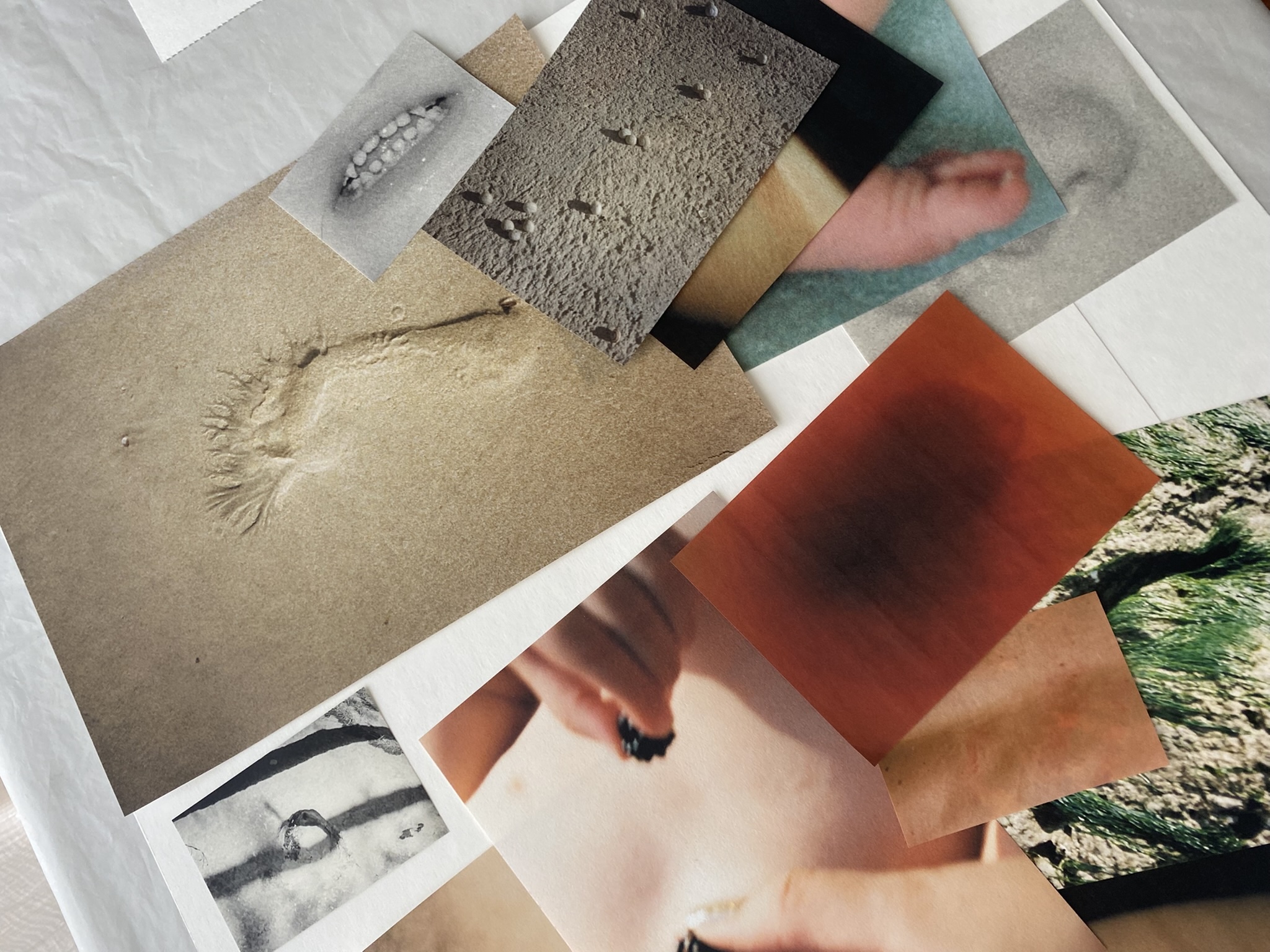
Marie Déhé, Process documentation, 2026. Image courtesy of the artists.
‘Atlas’ brings together the photographic works of London-based artist Benedict Brink and Paris-based artist Marie Déhé. Over a period of four years, Brink and Déhé have developed a shared practice, not as co-making, but through an ongoing exchange and inquiry into the photographic image. Images are shared, sent, and returned; conversations unfold; references circulate. Within this process, each photograph is understood less through what it represents than through what it sets into motion: a gesture, a thought, a memory, a reference. Human bodies, landscapes, dead animals, fragments of the everyday — the photographic images in ‘Atlas’ accumulate into seemingly disjointed and disparate fields. Oscillating between form and formlessness, meaning does not settle in the individual image, but emerges through encounters between images, and between image and viewer. In ‘Atlas’, photographic images carry affect, intention, and sensation, activating a field of relations that is at times bodily and porous, inviting that which exceeds what is immediately visible and nameable. Rather than stabilising meaning, they generate a loose choreography of relations, shifting our understanding from what images show to what they can do, and asking for slower forms of attention, care, and being-with. Images lean against one another, echo across distances, and form temporary constellations rather than fixed, linear sequences. The exhibition space takes shape through this accumulative logic of image-making, becoming a site of mapping and re-mapping where meaning is continually reconfigured. ‘Atlas’ emerges at an intermediary moment in Brink and Déhé’s ongoing dialogue. The exhibition stems from a curatorial invitation to bring this long-running exchange into a shared public space. In doing so, it extends the relational logic already present within the work itself: what began as a conversation between two artists becomes a shared field of encounter between images, viewers, and contexts. Rather than resolving this process, ‘Atlas’ holds it open, remaining attentive to its unfinished and evolving nature. Ultimately, ‘Atlas’ is open-ended constellation of images, bodies and time. In other words, a map without center.
In paralel, there is a public programme of workshops. Each workshop begins with an invitation to respond to, work through, or think alongside three terms that repeatedly surfaced during the development of Atlas: gesture, layer, and fold. By inviting practitioners from other disciplines and forms into this conversation, the programme seeks to extend these terms beyond photography and explore how they operate across different modes of making and thinking. Through this exchange, we hope to arrive at a deeper understanding of what these concepts can hold and how they might be activated in relation to the different contexts and encounters that Atlas has opened up. While Atlas takes the photographic image as its starting point, the exhibition ultimately considers the image as relational – something co-produced through various elements at play and thereby expanding the understanding of what an image can do. The workshops are therefore not only conceived as responses to the works on display, but also as ways of engaging with the worlds, questions, and relations that emerged through them.
Benedict Brink is a London-based artist working primarily with photography as a way of mediating encounter. Her work centres on intimacy and connection, thinking through the image as a space that can hold and reflect relationships. Images in her practice often operate as screens, mirrors, or alter egos, shifting between projection and reflection. Her subjects then ultimately linger in play with ideas of performance and persona. In a larger context, Brink plays with themes orbiting around the aesthetics of the beautiful, the broken, and the historical. Her approach is both documentary and poetic, moving freely across genres such as portrait, landscape, still life and nude. Rather than treating these categories in a fixed or academic way, she uses them loosely, allowing images to remain open and intuitive. In 2024, she curated ‘Tender Looks’ at Tenderbooks in London. Her first monograph, ‘LookTouch’, was published by Libraryman in 2022, followed by ‘Accumulative Impulses’ in 2025. Other recent projects have included Dwellings, a group exhibition at the South London Gallery and noisé reading room at SUHEHAUS, Shanghai. She completed an MRes in Art Theory and Philosophy at Central Saint Martins, University of the Arts London, in 2026. IG:@benedictbrink
Marie Déhé lives and works between L’Isle-Adam and Paris, France. She works with photography and book-based forms, and has developed her practice since 2016. She has published three books, including Correspondance (Asiro éditions, 2022), and has collaborated with Art Paper Editions on We Have Been Meaning To (2020) and Distant Intimacy (2022), both finalists for the Rencontres d’Arles Photo-Text Book Award. Her work has been exhibited at Tenderbooks in London, Libreria delle donne di Milano in Milan, and Le Consulat in Paris. Her work has also appeared in publications including Le Monde, Trigger, Vehicle, Partners, The Plant, and The British Journal of Photography. She is currently developing a collective research and archival project on artist mothers. IG:@mariedehe
Katharina Uhe is a London-based visual consultant, editor and facilitator working across exhibition-making, publishing and collaborative research. Her practice is concerned with how images circulate socially, what kinds of relations they produce, and how public and exhibition spaces can operate as sites for inquiry and collective learning. Often using the image as a mediator or invitation, she is interested in creating contexts where meaning can remain open long enough for new forms of exchange and understanding to emerge. She holds an MRes in Advanced Practices and a Postgraduate Diploma in Contemporary Art Theory from Goldsmiths, University of London, and teaches in the Photography and Fine Art Department at the University of East London. In 2022, she co-organised Dust Off Prints, a fundraiser for War Child UK. In 2024, she joined Dr. Elham Puriya-Mehr in developing a nomadic non-profit platform operating between London, Tehran and Vancouver, dedicated to transnational artistic exchange. In 2025, she joined the jury of un/fund and currently mentors emerging visual artist Tengbeh Kamara as part of their 2026 development programme. Alongside this, she has contributed to several artist publications as an editor and writer. IG:@katharina_uhe
Public Programme Artists Bios:
Adam Moore is transdisciplinary artist, dancer, curator, and writer creating multidisciplinary performance installations and situated works. He playfully examines the fabric and spirit of life translating the ephemeral and precarious substance of the world at large into sensual, experiential and affective encounters across media. He is a Leverhulme Performing Arts Scholar and holds an MFA degree in Dance Creative Practice from Trinity Laban and Independent Dance. He was the inaugural V&A East Storehouse artist in residence (2025) and the inaugural V&A East Artist X Bow Arts Artist Fellow researching local ecologies and materials at the London Docklands (2023-24). He teaches BA Fine Art, Photography and Commercial Photography at The University of East London. IG:@adameastlondon
Lu Rose Cunningham, based in London (UK), loves winged creatures and wetlands. Lu’s writing often explores time through art and everyday encounters. Cunningham’s art writing has been presented at Leeds Art Gallery; The Hepworth; South London Gallery; Wysing Arts Centre; The Barbican and SIZE MATTERS, Vienna. Cunningham has written for independent journals Pala Press; SPAM; MAP Magazine, Still Point Journal, JAWS, and WORMS Magazine. She is co-founder of London residency space The Writers’ Room, supporting practitioners at the intersection of image and text. IG:@lurosecunningham