
‘Untamed’
Julia Padilla
Curated by Gema Darbo
Presented by Apsara Studio
November 12th- 28th, 2026. Apsara Studio, 200 Battersea Park Rd, SW11 4ND London
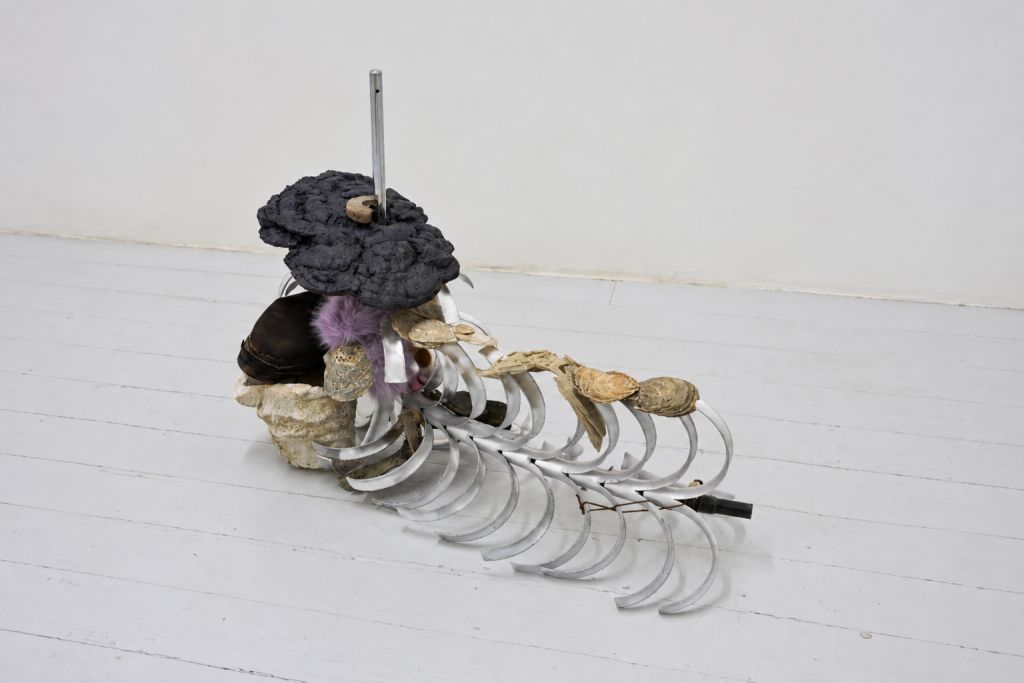
Installation view Julia Padilla. Gasworks 2026. Photography: Peter Otto (@artdocunet)
The river from her childhood, near Córdoba, Argentina, is the first thing Julia Padilla mentions when explaining what drew her to explore the less visible, less glamorous aspects of the river that flows through London. The River Thames, which I have been crossing for years, still serves as a tangible economic boundary between the north and south of the city, while its streams have vanished from sight, buried and rendered invisible since the Victorian era. One of these, the River Effra, has become an inseparable companion—both physical and dreamlike—to a new body of work by the Buenos Aires-based Argentine artist, now presented in her first solo exhibition in London.
As if it had shed the confines of a cylinder, the copper of the pipe—through which water flows unseen—expands to cover in its entirety the flat surface of the drawing. The solid, brilliant copper-hued metal fills a space that might otherwise appear vast and empty, anchoring our gaze and inviting us to immerse ourselves. Water, typically channelled and contained for our use and enjoyment, is reimagined through the gesture Julia Padilla proposes in this series of sculptures, installations, and drawings (all titled Untitled, 2026). Padilla does not merely incise a pipe to let the river flow through; rather, she transforms the material’s casing into a mediated space where bodies overlap—layers that must inevitably break apart, only to be reassembled once more. Subjected to the pressures and lightness of one body pushing against another—and swept away by the centrifugal force of the River Thames, which both destroys and shelters everything—they reveal glimpses of that turbulent underwater world where a length of rope, a paint tin, scraps of metal, a shoe sole, and the carcasses of dead animals are suddenly laid bare.
I was interested in what myths might exist about these rivers, and in the empathy of the people who knew them. (…)
When one is very calm, with a very precise focus, one sees a great many things.
Julia Padilla
Walking alongside Julia—entering her daily routine for the sheer blessing of short living together—I observe, through my art historian and curator eyes, an artistic practice that carries with her the studio. Moving lightly, almost skipping gait, her attentive gaze alights upon elements scattered across the terrain. In turn, Julia allows herself to be marked by that landscape, bearing upon her own body and limbs the other bodies she encounters and gathers. I recall thinking that a true symbiosis with the territory was taking place within her—a kind of animalistic devotion, a mimesis with every body, whether living or dead, that her eyes elevated. Little by little, she would absorb this matter, giving it new forms through the act of assemblage.
In her daily journeys through the city of Buenos Aires, her keen eye—almost instinctively—absorbs and salvages objects and “whims” that inspire new forms. Last spring in London, however, the artist residency at Gasworks provided her with a precious period of focused concentration. Her process then took on the nature of a prescribed practice: walking became a solitary ritual, one that Julia undertook in a methodical and conscious way. Setting out toward the mouth of the River Effra—just a few meters from Oval—the fifteen-minute walk from her indoor studio to her true, open-air studio became an act of pure, highly concentrated wandering. While there was no set itinerary—and she took care to avoid repeating routes or movements—the destination remained constant. This daily, focused ritual of traversing an unfamiliar city keeps one’s eyes attuned to the new and the unknown. Julia identified and collected elements that seemed to present themselves to her along the way: some were sharp-edged—curious, undulating pipes that seemed designed not to channel water, but to inflict wounds or serve as barriers—while others caught her eye with their vibrant, entropic colours or wild, uncontained fringes. Once brought back to the studio and processed, these objects—whether viewed individually or in combination—undergo a transformation; they become part of a new exercise in assembly and metamorphosis. The finished works continued to evolve throughout the installation period, with Julia incorporating further remnants salvaged from the Effra. This is a unique aspect of the opportunity offered by the Apsara studio: the chance to revisit a specific stage of the creative process—after the practice has had time to settle—and to return to it with the composure that distance provides. These artworks continue to grow through the exhibition process, supported by the curatorial guidance of Gema Darbo. Julia sought to allow the installation to undergo a subtle transformation—to assimilate the vernacular architecture of Apsara Estudio and, in doing so, granted herself a new opportunity to reconnect with a past friendship with the River Effra.
Traversing the terrain, embodying her absent life, or the concentrated and intimate ritual itself, are for Julia opportunities to maintain a friendship. With whom? When I asked Julia what she planned to do when she returned to London, to the place she had dedicated months to and which led to this body of work, she told me without thinking, “meet the swan.” It refers to the black swan that appears in the video installation, which stands out from the underground world. Let’s hope the swan has responded to her call. The living dialogue affirms the untamed body of the river, which never ceases to flow, eventually escaping its containment pipes and resurfacing, regardless of how much infrastructure and governance may have sought to bury it. As Julia said, the river stopped producing fear, succumbing to a liberating feeling.
María Montero Sierra
Julia Padilla was born in Buenos Aires in 1991, where she lives and works. In 2026, she was an artist in residence at Gasworks in London and received the Premio Talento Joven OPENING Fundación Banco Sabadell (2nd edition) at ARCOmadrid. She has also taken part in the ZONA residency in Salta, Argentina. Her solo exhibitions include Insecta at Centro Cultural Recoleta (2024), curated by Javier Villa, and Pariente at Fundación El Mirador (2021), curated by Laura Ojeda Bar. Earlier solo shows include Afelpada at Gachi Prieto Galería (2020) and El comienzo de los héroes at Naranja Verde (2014). She has taken part in group exhibitions including Soberanía de las cosas, Palacio Libertad (2025), curated by Jazmín Adler; Dibujar es crear mundos, Museo de Arte Moderno de Buenos Aires (2024), curated by Raúl Flores and Victoria Noorthoorn; Destructivo Arte, Aldo de Sousa Galería (2024), curated by Carlos Herrera; Nostalgia Sensorial, Video Proyect, Trapiche Pinta BAphoto (2022); Antes del fin de los sueños, CCEBA (2022); Después de la naturaleza, Zúrich Art and Sustainability Programme, arteBA (2022), curated by Sofía Dourron; Cuerpos Mutantes, Museo de Arte Moderno de Buenos Aires (2022); La larva y el pantano, Fundación Andreani (2022); Simbología, Centro Cultural Kirchner (2021); Programa KM1, Museo de Arte Moderno de Buenos Aires (2021); Cosecha Herida, Centro Cultural Recoleta (2019); and A punto de caer, Espacio Munar (2018). She has also participated in art prizes and exhibitions including the 28th Premio Klemm; the Bienal de Arte Sacro at the Museo Nacional de Arte Decorativo, Buenos Aires (2026); Premio 8M; Bienal de Arte Joven; Premio Fundación Fortabat; Salón Nacional de Rosario; Salón Nacional de Artes Visuales; Salón Nacional de Tucumán; Premio UADE; Fundación Andreani; Fundación Williams; Ópera Prima at Casa del Bicentenario; and Proyecto A. She has worked with Ernesto Ballesteros and José Luis Landet through studio critique sessions. Her training includes Hito Cultural; Artistas x Artistas at Fundación El Mirador; PAC – Programa de Arte Contemporáneo at Gachi Prieto Galería; and ABC at Pan y Arte. She has also taken workshops with Nicanor Araoz and Flavia Da Rin through SpookyVision, and attended critique sessions and writing workshops with María Gainza, Silvia Gurfein and Cecilia Pavón.